Essay
Dance: Vertical View
Essay by Dr Anne Scott Wilson
A Collaborative Response to Dance (1979)
Dance: Vertical View is a three-way collaboration conceived by Dr Irene Barberis as a response to Dance (1979), the landmark work by choreographer Lucinda Childs, composer Philip Glass, and artist Sol LeWitt. The structure of the response mirrors that of the original: each collaborator takes up a position in relation to one of the 1979 artists. Irene responds to Sol LeWitt through architectonic gridwork and video co-direction. Sarah responds to Philip Glass through sound and music. I respond to Lucinda Childs through choreography, while producing and co-directing the video with Irene. This mapping was Irene's founding decision, and it established the logic of everything that followed. We were not three artists adding separate contributions to a shared container. We were three practices in constant conversation, each shaping the others as the work developed.
The project had no major commission behind it. It began with modest research funding from Deakin University and grew through what we came to call a 'love job,' each of us contributing time, skill, and material from our existing practices because we believed in what the work could become. That economic reality mattered. Without institutional weight dictating schedules or outcomes, the process stayed open, responsive, and genuinely collaborative. We could test ideas in the studio and follow what emerged rather than executing a fixed plan.
The Original Work
Understanding what we were responding to matters. When Dance premiered on 11 November 1979 at the Brooklyn Academy of Music, it provoked hostility. Deborah Perlberg's review in Artforum describes a work of 'pure physical joy,' yet contemporary accounts report audience members walking out; Philip Glass has recalled people throwing things at the stage (Perlberg, 1980; Glass, in Cummings, 2011). The work was radical in its austerity: no narrative, no set design, no theatrical affect. Only dancers executing systematic patterns, Glass's additive and reversing score, and LeWitt's film projection doubling the live performers from overhead.
By the early 2000s, the same work had entered the repertoire of the Lyon Opera Ballet and toured internationally to acclaim. That transformation, from rejection to canonical status, is itself significant. Between 1979 and the present, algorithmic processes became embedded in daily life; instruction-based systems moved from the domain of conceptual art and computer science into the ordinary. Dance now feels not alienating but legible, even beautiful. Its rigorous patterning and additive logic anticipated a perceptual shift that the rest of the culture took decades to catch up with. This recognition is part of why a contemporary response felt timely: we wanted to inhabit those systematic methods from inside our own practices and see what they could generate in a 21st-century Australian context, Melbourne/Naarm, 2025.
Shared Ground
The collaboration drew on deep shared histories. Irene and I trained together in classical ballet as young dancers. Jennifer Homans describes ballet as 'a system of movement as rigorous and complex as any language,' possessing its own 'rules, conjugations, and declensions' (Homans, 2010). That shared lived experience of intense studio practice meant we understood each other's ideas as they emerged in the making of Dance: Vertical View. Sarah carried her own parallel discipline: she had studied piano to an advanced level from childhood, and her ongoing work draws on architecture and sound; for this project she expanded her practice into musical composition for the first time. For all three of us, disciplines learnt young became a connective tissue of our collaboration.
Irene also brought direct knowledge of the artists we were responding to. She had met Sol LeWitt and encountered members of the Judson Dance Theatre circle, including Yvonne Rainer. That firsthand connection flavoured our reception of the original work. When we began to study Dance together, watching the interviews with Childs and Glass, reading LeWitt's writings, studying the work's subsequent reception, we were not approaching it as distant history. Irene's experience made it immediate and specific, which in turn sharpened the question each of us had to answer: given that these methods are well documented, how do we respond honestly rather than imitate?
The Grid as Participant
Irene's response to Sol LeWitt centred on the grid as an architectonic system. LeWitt's 1967 essay 'Paragraphs on Conceptual Art' articulated his position: 'the idea becomes a machine that makes the art' (LeWitt, 1967). His grid is not metaphorical or decorative; it is a scoring system that makes process visible. Ann-Sargent Wooster observed that when LeWitt placed dancers within the grid for Dance, the figures 'served to humanize it,' stressing the 'underlying physical/anthropomorphic quality' of his structures (Wooster, 1980). This distinguishes LeWitt's use of the grid from later deployments of it as a symbol of confinement, such as Beckett's Quad or Nauman's video performances. Where those grids operate as images of constraint, LeWitt's grid is generative: a structure that enables improvisation within defined limits.
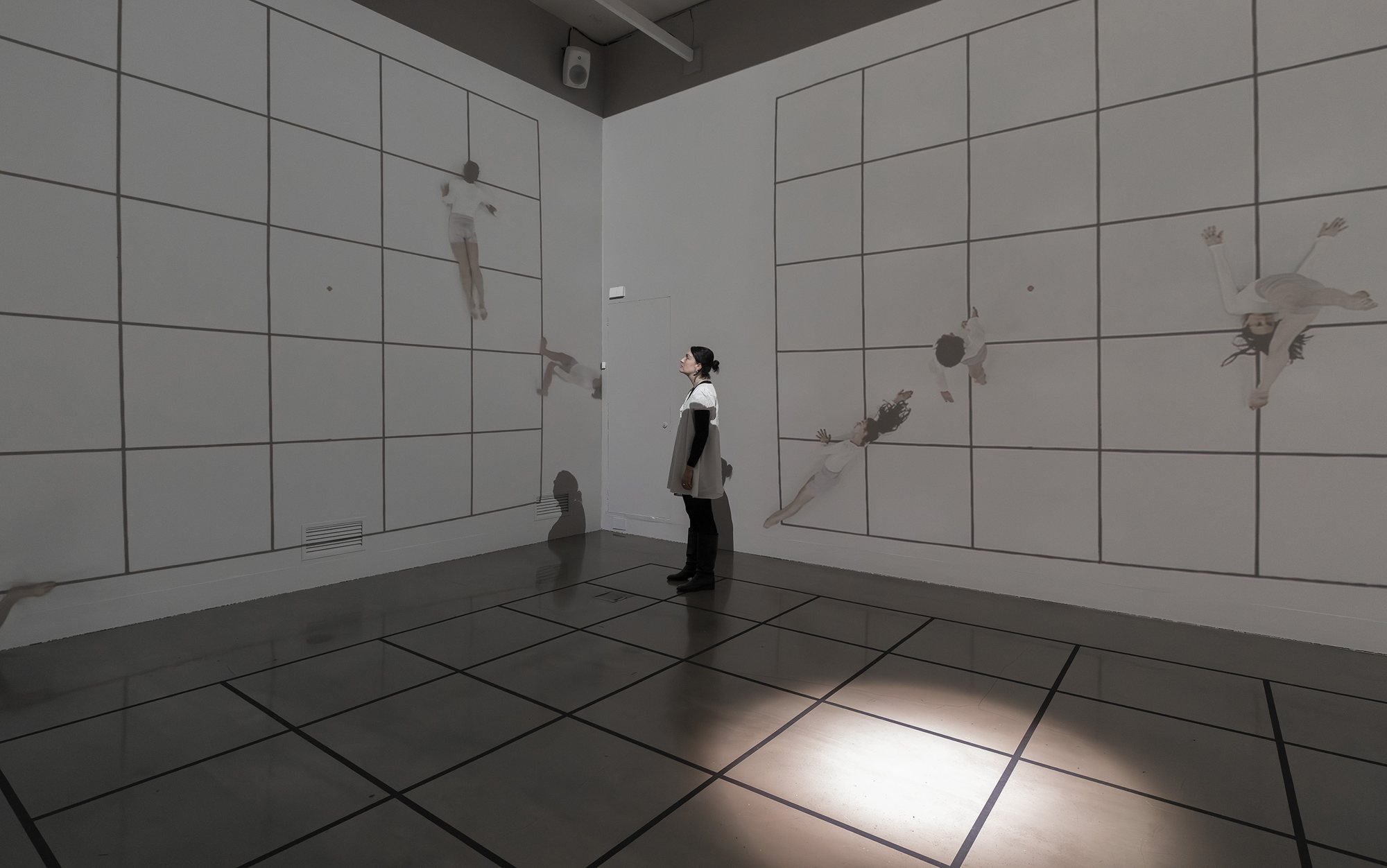
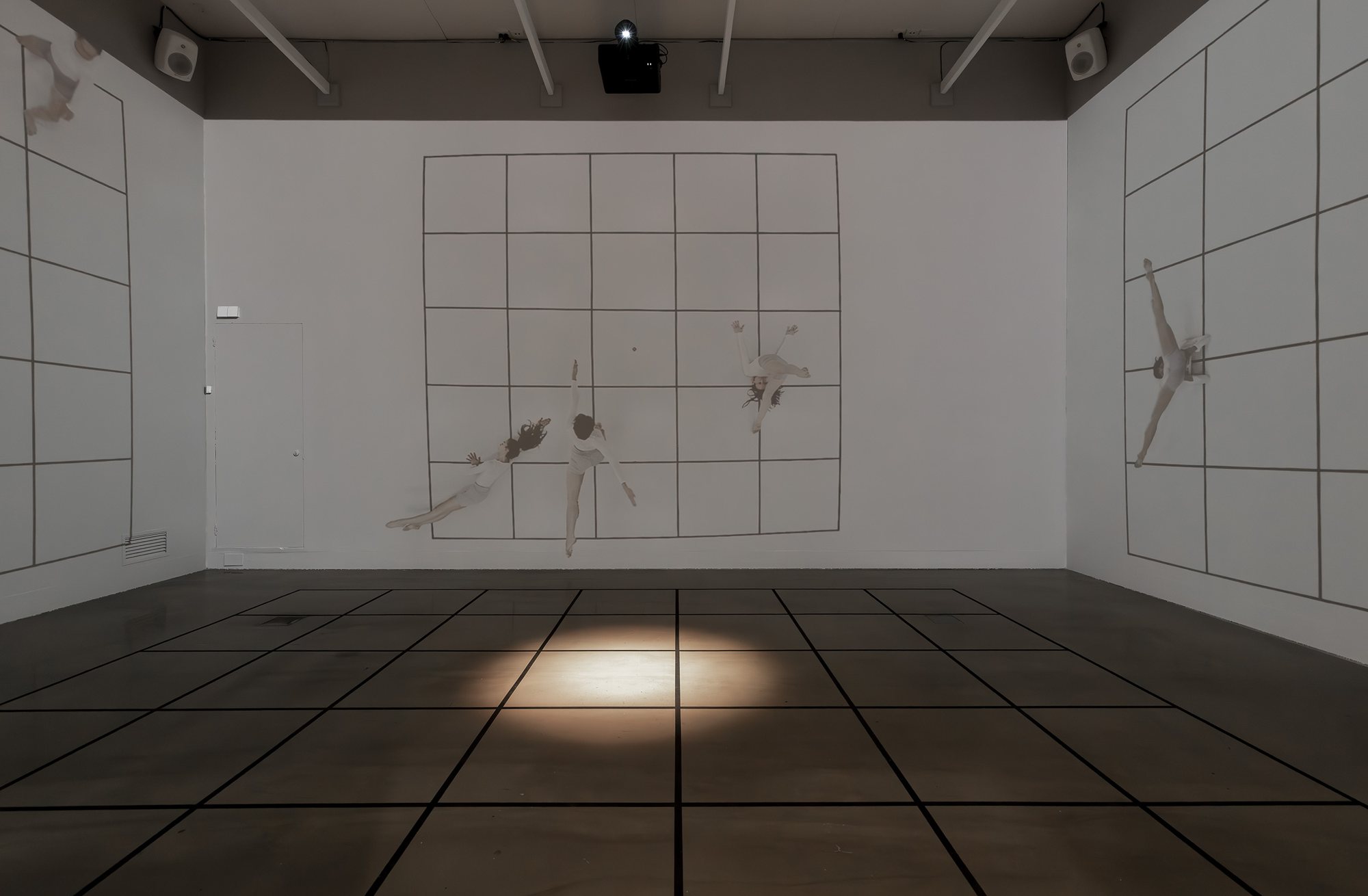
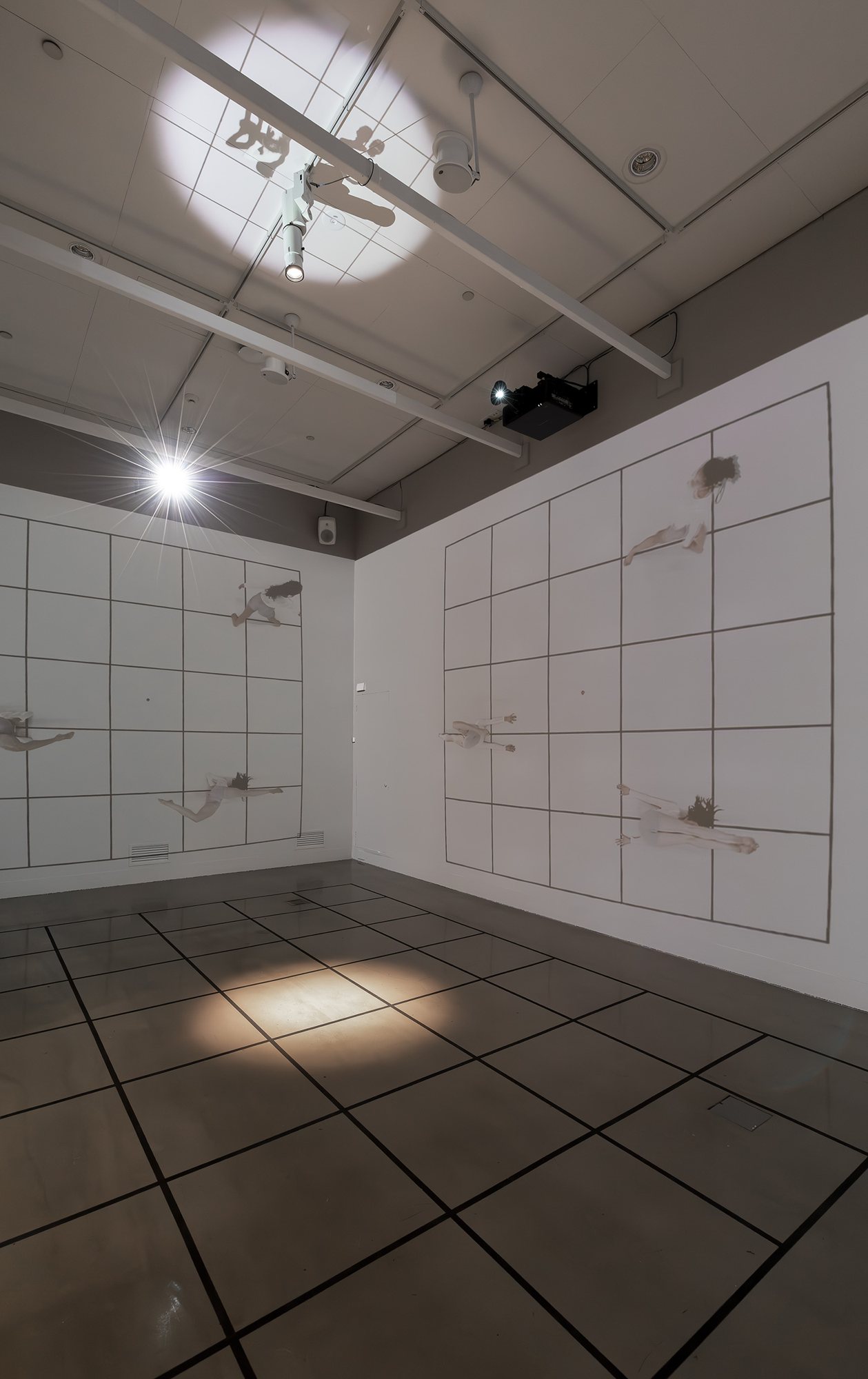
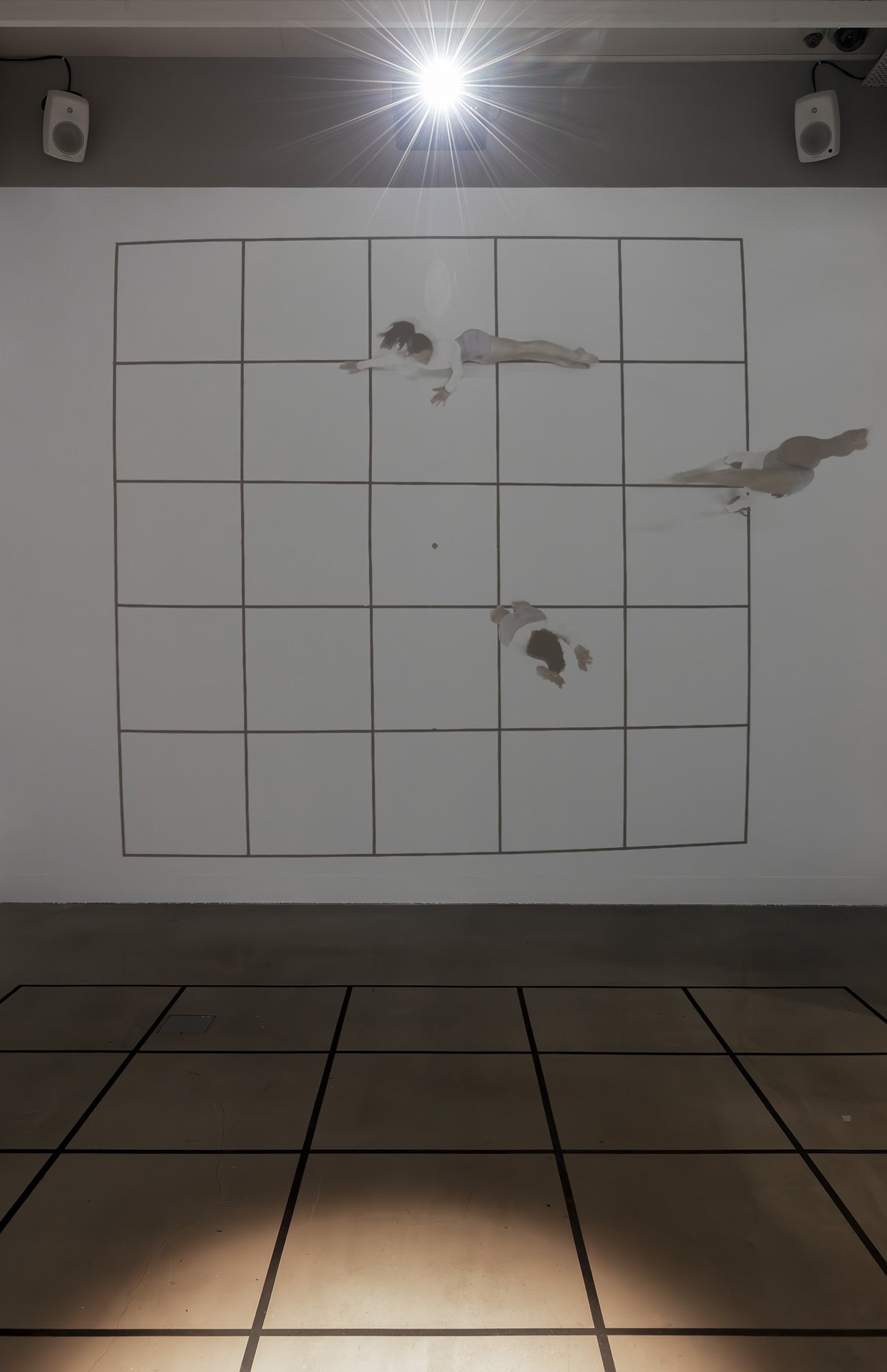
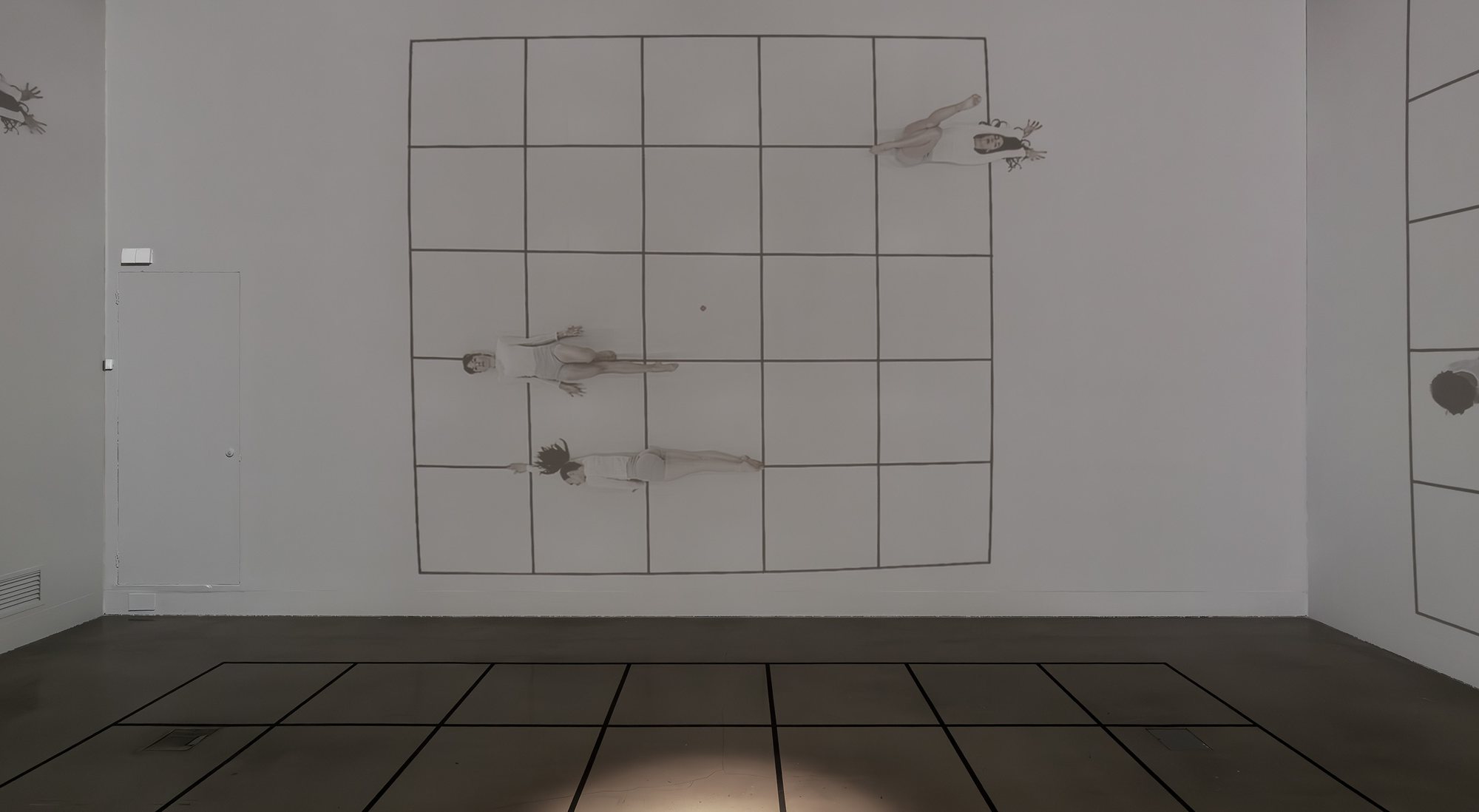
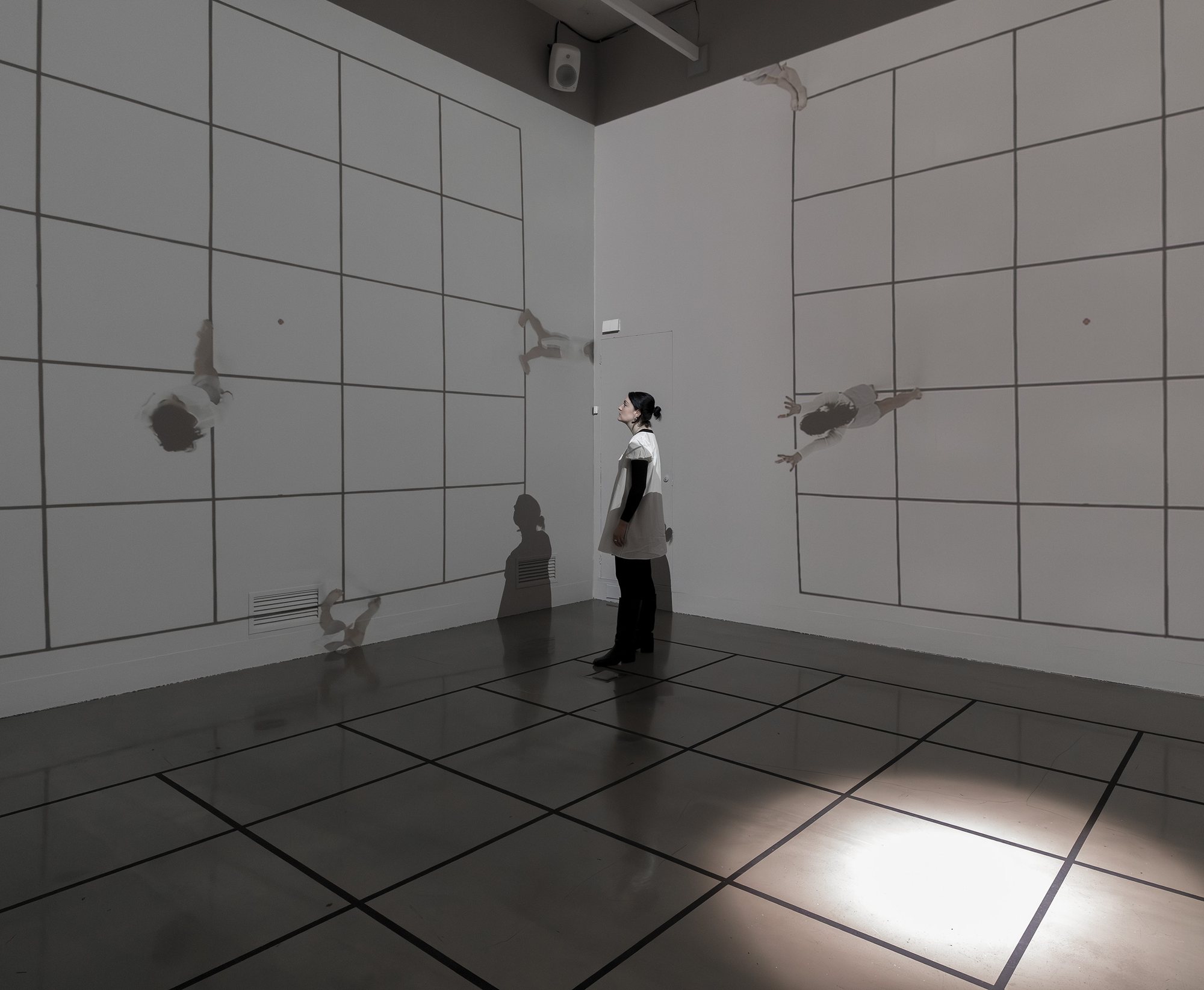
For Dance: Vertical View, we constructed a five-metre square grid on the studio floor, marked in one-metre increments with tape and a defined centre point. The one-metre module was chosen as a human scale: approximately the length of a stride, the reach of an arm's extension, the distance of a controlled fall. The grid translated abstract spatial relationships into bodily units. The marked centre functioned as what dancers call 'finding centre,' a constant act of spatial and gravitational calibration. The grid was not scenery. It was an active participant in the work, determining the sequence, the spacing, and the spatial logic of every movement phrase the dancers performed.
Into the Studio: The M Collective and the Process of Making
The question of who would dance was inseparable from the question of how the work would be made. Childs's company comprised dancers with classical training and the capacity to memorise and execute long, pattern-based sequences with precision. We needed performers with comparable embodied intelligence, seasoned professionals who could absorb complex instructions and expand upon them through their own physical problem-solving. The M Collective, Chimene Steele-Prior, Jessica Thompson, and Arianna Marchiori, brought exactly this: years of classical and contemporary training, deep performance histories, and the ability to work within constraints while making independent interpretive choices.
We began in a dance studio at Deakin University with a roughly imagined grid, using shoes to mark out the corners. The early sessions were deliberately experimental: testing the idea of doublings, reversals, and additions that Glass's score uses as structural principles. The choreographic process worked through elimination, determining what not to do in order to make the work legible from multiple simultaneous viewpoints. I gave the dancers a set of working instructions:
- think from above (maintain awareness of the overhead perspective);
- synchronise and resist (the grid is both anchor and provocation);
- magnetic dynamics (use the energy of repelling magnets to initiate movements relative to 'centre');
- bodily autonomy (no social or narrative interaction between dancers); and
- the break (use synchronised, choreographed sequences to punctuate the improvisation).
These instructions provided a way the choreography could emerge through rehearsal, adjustments, and collaborative refinement as the dancers' own responsiveness to the grid and to each other shaped the material.
This process externalised the rules at play. Our method required that the constraints be visible, testable, and open to negotiation. The grid was on the floor; the instructions were spoken and written; the dancers could see what system they were operating within and push against it unlike a conventional rehearsal where the choreographer's decisions remain internal until demonstrated.
Sound as Architecture
Sarah's response to Philip Glass addressed the temporal architecture of the work and bodily breath of the organ. Rather than music as accompaniment, Sarah's spatial practice treats sound (and music) as sculptural material: soundscapes of field recordings of body and architecture, tones, sustained arpeggios, and delicate textures that inhabit the space alongside bodies. Her contribution developed through a process closely tied to the movement, though partially composed independently.
During the rehearsal period, I shared video footage of the dancers working through Irene's grid, their body sounds audible, the spatial relationships and physical intensities visible. A pivotal moment occurred during one of these sessions, conducted over Zoom, with Sarah watching a rehearsal remotely. She began improvising on the piano/keyboard in real time as the dancers moved, and an unexpected synchronisation emerged. Her music aligned with the dancers' physical intensity and rhythmic inflections coalesced spontaneously with directional changes. None of this had been scored or pre-planned. It happened because Sarah had composed from inside the movement, and because all three of us were working within shared principles of process, duration, and spatial attentiveness.
Following instructions in silence requires sustained mental focus; dancing with music charges the body with another dynamic. Yet we discovered that the choreography held its coherence under both conditions. The synchronisation, when it occurred, felt uncanny rather than designed. This quality of unplanned convergence persisted as the work developed. No matter where in the sequence Sarah's composed sounds were later introduced, the movement and music fell into alignment.
In this we discovered a striking parallel with the original Dance. Childs came to the 1979 collaboration from a period, between 1973 and 1978, in which she had choreographed sixteen works performed entirely in silence, each propelled by what she called an internal pulse shared among the dancers (Childs, 'Notes on the Reconstructions'). Glass was, Childs has said, her first composer: 'before that, we didn't use music. I made works in silence' (Childs, in Wesemann, 2014). When she did choreograph Dance to Glass's score, she analysed its construction and designed a movement structure that would interact with it, 'play against it,' as she put it, rather than illustrate it. The result was two parallel architectures, similar but deliberately not mirrors of each other: 'the dancers always know where they are,' Childs explained, 'but they're not always exactly on the same count as Philip' (Childs, in Wesemann, 2014). Perlberg described the effect as dance and music working 'modularly and repetitively' so that they 'interlock naturally,' combining 'space, time and sound into a single physical unit' (Perlberg, 1980).
Something of this was at work in Dance: Vertical View. Where Childs built a parallel architecture to Glass's score, Sarah had composed from inside the movement itself, watching the bodies that had already been shaped by Irene's grid. The structures were entangled rather than independent, yet they retained enough autonomy that their convergence felt like discovery rather than illustration. Deborah Perlberg, writing about an earlier collaboration between Merce Cunningham and Meredith Monk, described how dance and music 'treated as totally separate entities that happened to be going on at the same time' could produce 'chance chords,' combined units of movement and sound (Perlberg, 1980). Our synchronisation was neither Cunningham's pure chance nor Childs's calculated counterpoint, but something shaped by a third condition: Sarah responded bodily with improvisation, the bodies had moved within Irene's grid, and the music carried all of this within it.
Crucially, the rehearsals also revealed that the dancers themselves are sonic producers. Feet striking the taped grid, weight shifts, the friction of limbs, and the breath of effort and recovery created an immediate percussive ecology, tactile, close, and rhythmically specific. Over time these sounds accrued their own identity and became part of the score. Childs's own silent works relied on precisely this quality (Bither and Rosenberg, 2014), and that history validated our decision to treat the dancers' body sounds not as background noise but as compositional material. Introducing and withdrawing Sarah's composed piano allowed us to modulate attention: at times the music enveloped the field; at others it receded so the dancers' percussive presence surfaced as the primary temporal organiser. The boundary between accompaniment and performance dissolved.
Accumulation and Affect
The structural convergences described above were also, and perhaps more fundamentally, emotional ones. This dimension is easy to understate in an essay about systematic methods, but it was central to the experience of making the work, and it has a precedent in how the original Dance is received.
When I first watched the video documentation of Dance on a laptop, the effect was overwhelming, not immediately, but cumulatively. It just grew as it went on. The repetitive structures, the additive layering of Glass's score, the dancers' mesmerizing patterning: what begins as legible and austere gathers force until, by the final sections, it has become something approaching transcendent. Luke Jennings, reviewing a 2011 revival for The Guardian, described being 'elevated to a state of exhilarated alertness, yet calm,' finding the work 'constantly fascinating' as its accumulative logic took hold (Jennings, 2011). The Philip Glass liner notes for the recording speak of 'unforgettable exuberance' that moves through registers of 'joyful innocence, intense erotic desire, tenderness, regret and, finally, acceptance,' a progression from jubilant opening to what Glass calls a 'visionary conclusion' (Glass, 2007). Lyndsey Winship, reviewing the 2019 Sadler's Wells revival, described textures that 'build unstoppably' through the final section, dancers who 'exude an elastic enjoyment' and approach the space 'with arms outstretched,' the whole work registering as an 'exhilarating pleasure cruise' (Winship, 2019). What all these accounts share is the recognition that emotional intensity is not opposed to structural rigour but generated by it: that systematic accumulation produces affect. Perlberg identified this quality at the outset: 'rare peaks of pure physical joy' (Perlberg, 1980). The joy is inseparable from the system.
Something parallel emerged in the choreography itself. The emotional register of the music, the strictures of the grid, and the dancers' bodily sounds synching with the flows and patterns that emerged, these combined to produce an unexpected quality of lift.
The structures held, yet what flowed through them was not mechanical. There was an emotional current running alongside the body sounds, a quality of feeling that arose from the music's interaction with physical effort and that grew stronger each time we returned to the studio.
Watching the original Dance accumulate its emotional force on a small screen, I recognised something of what we were already discovering in the studio: that rigorous process, given enough time and genuine responsiveness, generates feeling as reliably as it generates form.
A Plural View
In the original 1979 production, LeWitt's film was made separately and projected during the live performance as a doubled image; Childs did not co-direct or produce the film elements. In our response, Irene and I worked in constant conversation about how to capture the choreography within the grid's logic. This was a deliberate structural departure, not merely documenting the dance but making the recording process part of the collaborative investigation.
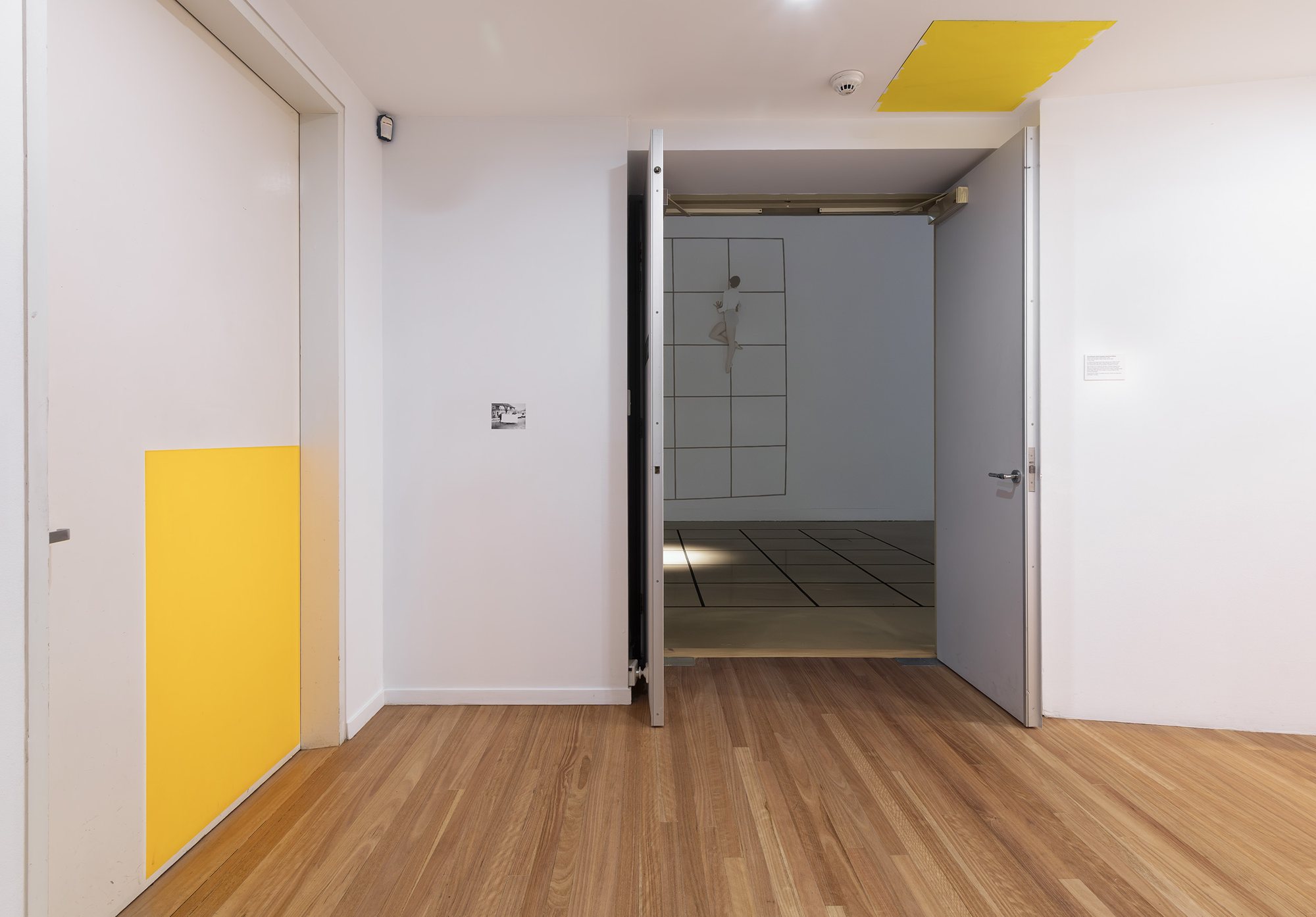
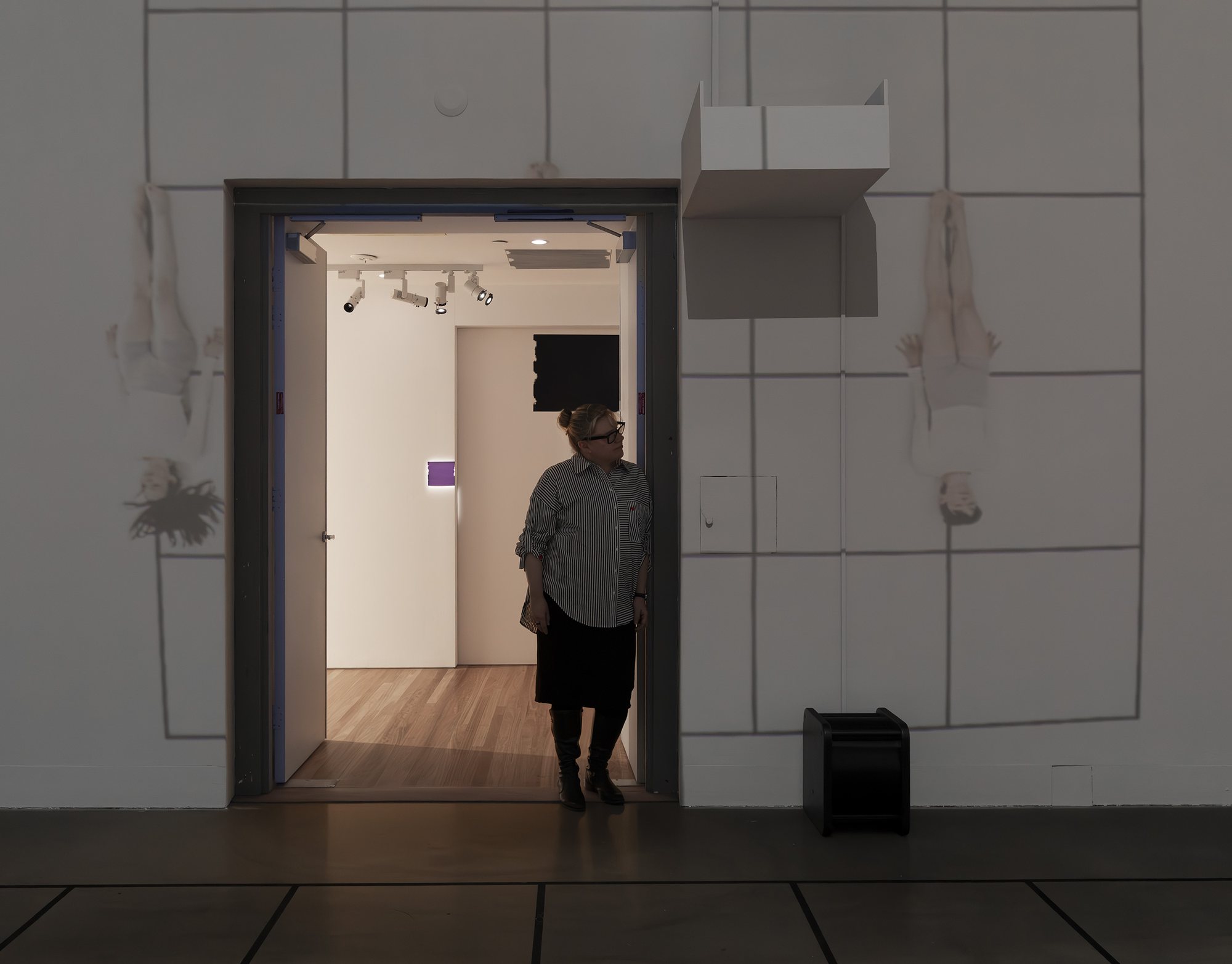
We replaced the single film projection of the original with a five-camera strategy, capturing diverse aerial and side viewpoints simultaneously. The aerial camera gave us the true vertical view, bodies and grid seen from directly above, the compositional pattern legible as a whole. The side cameras captured subjective, intimate perspectives: the weight of a landing, relative motion and dynamics of dance. Lighting was used deliberately to double the dancers' bodies through shadow, intensifying the graphical imprint on the floor from all angles. This shadow-doubling extended the grid's logic: where the tape marked fixed spatial intervals, the shadows' mutating forms morphed bodies with light.
The decision to shoot from five angles simultaneously draws upon a dancer's ability to visualize a sequence mentally yet in video, what reads as a clean line from above might collapse into confusion from the side, and vice versa. This constraint fed back into rehearsal, sharpening both the dancers' spatial awareness and our decisions about what to keep and what to discard.
What the Work Discovered
Dance: Vertical View is not an attempt to replicate Dance. It is an investigation into what could happen when the systemic methods of Childs, Glass, and LeWitt are inhabited by different bodies, in a different place and time, under different material conditions. What we discovered through making it is that setting up transparent constraints, a visible grid, a shared set of instructions, an evolving method of observation, critique and adjustment creates conditions for convergence that cannot be pre-planned. The unscored alignment between Sarah's music and the dancers' movement; the shadow-patterns that extended the grid beyond its taped boundaries; the dancers' body sounds that became part of the score: none of these were designed in advance. They emerged because the process was open enough to let them.
The collaboration also clarified something about the original work. Childs, Glass, and LeWitt insisted that the dance and the dancers are the 'material' of the work. We took that literally. Everything else, the grid, the video, the sound, exists in service of making that material visible, audible, and legible from perspectives we do not ordinarily inhabit. The moving, remembering body remains the subject. The systems exist to reveal what it can do, and what it can feel. The emotional dimension of the work was not something we added to the structure. It was something the structure released.
References
- Bither, Philip and Susan Rosenberg. 'An Art of Refusal: Lucinda Childs's Dances in Silence.' In A Steady Pulse: Restaging Lucinda Childs, 1963–78. Pew Center for Arts & Heritage, 2014. http://danceworkbook.pcah.us/asteadypulse/texts/refusal.html
- Childs, Lucinda. 'Notes on the Reconstructions.' In A Steady Pulse: Restaging Lucinda Childs, 1963–78. Pew Center for Arts & Heritage, 2014. https://danceworkbook.pcah.us/asteadypulse/texts/reconstructions.html
- Childs, Lucinda. Interview by Arnd Wesemann. November Magazine, 2014. https://www.novembermag.com/content/lucinda-childs/
- Cummings, Chris. 'Controversial Dance Returns 30 Years after First Run.' MPR News, 7 April 2011. https://www.mprnews.org/story/2011/04/07/childsglass
- Glass, Philip. Liner notes for Dance Nos. 1–5. Nonesuch Records, 2007. https://philipglass.com/recordings/dance_nos1-5/
- Homans, Jennifer. Apollo's Angels: A History of Ballet. Random House, 2010.
- Jennings, Luke. 'Lucinda Childs Dance Company: DANCE – review.' The Guardian, 19 October 2011. https://www.theguardian.com/stage/2011/oct/19/lucinda-childs-dance-company-review
- LeWitt, Sol. 'Paragraphs on Conceptual Art.' Artforum, vol. 5, no. 10, Summer 1967, pp. 79–83.
- Perlberg, Deborah. '"Dance": Lucinda Childs, Philip Glass and Sol LeWitt.' Artforum, vol. 18, no. 5, January 1980, pp. 26–30. https://www.artforum.com/features/dance-lucinda-childs-philip-glass-and-sol-lewitt-208982/
- Scott Wilson, Anne. Memory, Motion, and Imagination: An Investigation into the Subjective Experience of Studio Practice. Doctoral dissertation, Monash University, 2004.
- Winship, Lyndsey. 'Lucinda Childs' Dance at Sadler's Wells Review: What a Difference Forty Years Makes.' Evening Standard, 14 June 2019. https://www.standard.co.uk/culture/dance/lucinda-childs-dance-philip-glass-sadlers-wells-b987171.html
- Wooster, Ann-Sargent. 'Sol LeWitt's Expanding Grid.' Art in America, vol. 68, no. 5, May 1980, pp. 143–147.
With thanks
M Collective Dancers: Chimene Steele-Prior, Jessica Thompson and Arianna Marchiori
Deakin University Media Resource Centre: Olivia Fisher, Georgia Wolfe, Mark Lasky-Davison, Tom Golder, Thomas Salisbury and Matthew Skarajew
Supported by Deakin University, Faculty of Arts and Education publication funding.